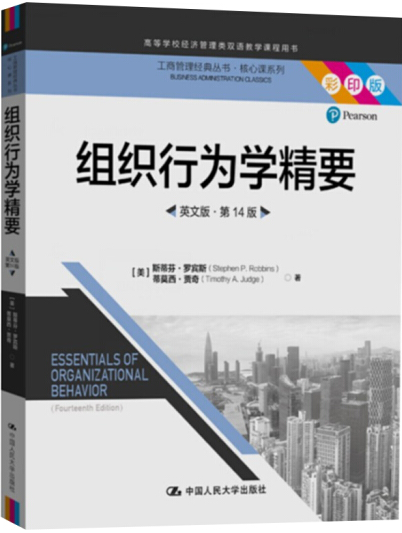
This book was created as an alternative to the 600- or 700-page comprehensive text in
organizational behavior (OB). It attempts to provide balanced coverage of all the key
elements comprising the discipline of OB in a style that readers will find both informa-
tive and interesting. We’re pleased to say that this text has achieved a wide following in
short courses and executive programs as well as in traditional courses as a companion
volume to experiential, skill development, case, and readings books. It is currently used
at more than 500 colleges and universities in the United States, Canada, Latin America,
Europe, Australia, and Asia. It’s also been translated into Spanish, Portuguese, Japanese,
Chinese, Dutch, Polish, Turkish, Danish, and Bahasa Indonesian.
KEY CHANGES FOR THE FOURTEENTH EDITION
• Increased content coverage was added to include updated research, relevant discus-
sion, and new exhibits on current issues of all aspects of organizational behavior.
• Increased integration of contemporary global issues was added into topic
discussions.
• Extensive reorganization of all chapters with new headings and subsections to
make navigating the print and digital versions of the text easier and bring important
content to the fore.
• Increased cross-references between chapters to link themes and concepts for the
student’s quick access and to provide a more in-depth understanding of topics.
• New assisted graded questions that students can complete and submit via Pearson
MyLab Management are provided for each chapter.
• A new feature, Try It , has been added to 14 chapters to direct the student’s atten-
tion to Pearson MyLab Management simulations specific to the content in the text.
• A new blue box feature has been introduced in 8 chapters. These box features
highlight global examples of the section covered.
RETAINED FROM THE PREVIOUS EDITION
What do people like about this book? Surveys of users have found general agreement
about the following features. Needless to say, they’ve all been retained in this edition.
• Length. Since its inception in 1984, we’ve tried diligently to keep this book in the
range of 325 to 400 pages. Users tell us this length allows them considerable flex-
ibility in assigning supporting materials and projects.
• Balanced topic coverage. Although short in length, this book continues to provide
balanced coverage of all the key concepts in OB. This includes not only traditional
topics such as personality, motivation, and leadership but also cutting-edge issues
such as emotions, diversity, negotiation, and teamwork.
• Writing style. This book is frequently singled out for its fluid writing style and ex-
tensive use of examples. Users regularly tell us that they find this book “conver-
sational,” “interesting,” “student friendly,” and “very clear and understandable.”
• Practicality. This book has never been solely about theory. It’s about using theory
to better explain and predict the behavior of people in organizations. In each edi-
tion of this book, we have focused on making sure that readers see the link between
OB theories, research, and implications for practice.
• Absence of pedagogy. Part of the reason we’ve been able to keep this book short in
length is that it doesn’t include review questions, cases, exercises, or similar teach-
ing/learning aids. It continues to provide only the basic core of OB knowledge, al-
lowing instructors the maximum flexibility in designing and shaping their courses.
• Integration of globalization, diversity, and ethics. The topics of globalization and
cross-cultural differences, diversity, and ethics are discussed throughout this book.
Rather than being presented only in separate chapters, these topics have been wo-
ven into the context of relevant issues. Users tell us they find that this integrative
approach makes these topics more fully part of OB and reinforces their importance.
• Comprehensive supplements. Although this book may be short in length, it’s not short
on supplements. It comes with a complete, high-tech support package for both fac-
ulty and students. Instructors are provided with a comprehensive Instructor’s Manual
and Test Bank, TestGenerator, and PowerPoint slides. The Pearson MyLab Manage-
ment course provides both instructors and students with various types of assessments,
video exercises, decision-making simulations, and Personal Inventory Assessments.
|

 中国大学出版社协会 |
首页 |
宏观指导 |
出版社天地 |
图书代办站 |
教材图书信息 |
教材图书评论 |
在线订购 |
教材征订
中国大学出版社协会 |
首页 |
宏观指导 |
出版社天地 |
图书代办站 |
教材图书信息 |
教材图书评论 |
在线订购 |
教材征订