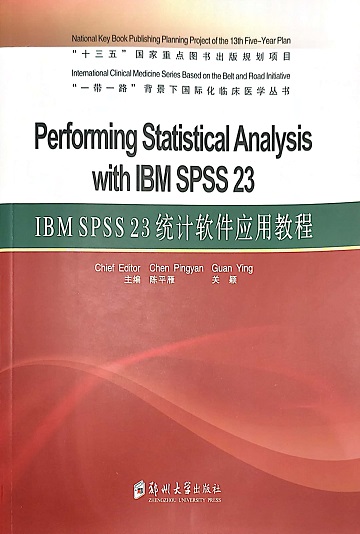
本书以IBM SPSS 23为准,以统计理论为主线,详细介绍了SPSS中的界面操作、数据管理、统计图表制作、统计描述和其他一些常用统计分析方法的原理与实际操作等。本书引用了大量来自医学和生物学研究的实际数据,这些例子来自于日常科研项目,便于理解,所以可以作为临床医生和其他医药卫生从业人员在进行统计分析方面的参考书。 Performing Statistical Analysis with IBM SPSS 23 is written to become an aid in the beginning statistical analysis to students or clinical doctors whose mathematical background is limited to basic algebra. The book puts focus on data file formats, operation steps, results' interpretation, and tries to avoid a deep introduction to programming content and statistical method background. Therefore, the book is mainly aimed at medical students, or students from other healthcare related professions such as pharmacy or public health services who need to face with a lot of data from patients monitoring and laboratory tests.
作者简介:
章节目录:
Chapter 1 Overview and Basic Steps in Data Analysis 1.1 The operating environment of IBM SPSS 23 1.2 Windows and view 1.3 Data file creation, import and export 1.4 Attribute setting of data reading and writing
Chapter 2 Data Management 2.1 Data Edition 2.2 Data Validation 2.3 Identify Duplicate Cases 2.4 Identify Unusual Cases 2.5 Sort Cases 2.6 Sort Variables 2.7 Transpose 2.8 Merge Files 2.9 Data Restructure 2.10 Aggregate Data 2.11 Copy Dataset 2.12 Split Files 2.13 Select Cases 2.14 Weight Cases
Chapter 3 Transform 3.1 Computing Variable 3.2 Counting Values within Cases 3.3 Shifting Values 3.4 Recoding data 3.5 Automatic Recode 3.6 Visual Binning 3.7 Optimal Binning 3.8 Ranking Cases 3.9 Replacing missing values 3.10 Random number generators
Chapter 5 Compare Means Chapter 6 General Linear Model Chapter 7 Correlation &Regression Chapter 8 Classify Chapter 9 Reliability Analysis Chapter 10 Nonparametric Tests Chapter 11 Survival Analysis Chapter 12 Graphs Chapter 13 Comprehensive Data Analysis
References Appendix
精彩片段:
Performing Statistical Analysis with IBM SPSS 23 is written to become an aid in the beginning statistical analysis to students or clinical doctors whose mathematical background is limited to basic algebra. The book puts focus on data file formats, operation steps, results' interpretation, and tries to avoid a deep introduction to programming content and statistical method background. Therefore, the book is mainly aimed at medical students, or students from other healthcare related professions such as pharmacy or public health services who need to face with a lot of data from patients monitoring and laboratory tests.
There are thirteen chapters. Chapter 1: Overview and basic steps in data analysis, Chapter 2: Data management, Chapter 3: Transform, Chapter 4: Analysis of descriptive statistics, Chapter 5: Compare
means, Chapter 6:General linear model, Chapter 7:Correlation & regression , Chapter 8:Classify, Chapter 9:Reliability analysis, Chapter 10: Nonparametric tests, Chapter 11: Survival analysis, Chapter 12: Graphs,13:Comprehensive data analysis.
A number of important features have been made in this book. One of the important features of this book is citing a lot of actual data from medical and biological researches. The examples are close to daily scientific research projects, so this book can work not only as an introductory level textbook, but also as a handbook for clinicians or other healthcare professionals in data analysis. Furthermore, a detailed explanation of the analysis results is another outstanding feature of this book. Detailed and accurate interpretation is particularly helpful for correct understanding and reasonable application of statistical methods for readers. A special section called comprehensive data analysis included in this book is another feature of this book. This new content requires students to work with a dataset to perform various statistical tests, and then summarize the results. We also provide a flow chart to aid readers to choose appropriate analytical method based on the data characters.

 中国大学出版社协会 |
首页 |
宏观指导 |
出版社天地 |
图书代办站 |
教材图书信息 |
教材图书评论 |
在线订购 |
教材征订
中国大学出版社协会 |
首页 |
宏观指导 |
出版社天地 |
图书代办站 |
教材图书信息 |
教材图书评论 |
在线订购 |
教材征订