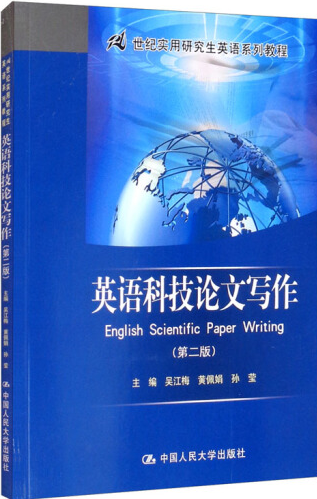
《英语科技论文写作》以论文通常篇章结构逐节讨论的思路构建了体系,分为9个章节。每节中以各学科普遍遵循的论文写作方法,即论文各部分所报告的科研内容、承载的功能和使用的语言特点为教学重点,设计教学和操练。 修订版除增删原书内容,还增加了style and coherence 一节,强化在科技论文写作中文体的特点和文字连贯性的技巧。包括特定词汇、句型的使用原则,上下文信息连贯、顺畅的组织方法等。帮助学习者从机械生硬地套用四六级写作模板的逻辑词汇中得到提高,真正做到学以致用。
Unit 1 Information Searching Section A Information Sources Section B Searching Techniques and Strategies Section C Search Tips About Google Section D Exercise Unit 2 Research Paper and Title Section A Research Paper Section B AIMRD Structure Section C Title Section D Exercises Section E Formal Style Unit 3 Abstract Section A IMRC Format Section B Linguistic Features Section C Formal Language Section D Exercises Unit 4 Introduction Section A Elements and Organization Section B Linguistic Strategies Section C Information Flow: Old-to-New Pattern Section D Exercises Section E Current Situation and Issues Unit 5 Materials and Methods Section A Overall Organization Section B Materials Section C Experimental Design Section D Data Analysis Section E Use of Tense and Voice Section F Academic Style: Verbs and Verbal Phrases Section G Exercises Unit 6 Results Section A Elements and Organization Section B Linguistic Strategies Section C Simple, Compound and Complex Sentences (1) Section D Exercise Unit 7 Tables and Figures Section A Tables and Figures Section B Legend Section C Sentence Construction Section D Simple, Compound and Complex Sentences (2) Section E Exercise Unit 8 Discussion and Conclusion Section A Elements and Organization Section B Linguistic Strategies Section C Coherence: Logical Connection (1) Section D Exercise Unit 9 References and Notes Section A References, Works Cited and Bibliography Section B Authors’ Names Section C Format and Ordering of Sources Section D Notes Section E Coherence: Logical Connection (2) Section F Exercise
精彩片段:
Unit 1 Information Searching
Section A Information Sources
1、 There is a list of information sources for academic writing in the table below. Do you know what they are? Which are commonly used in your
paper?
books; articles; government documents; manuscripts; archival materials; maps;
visual materials; dissertations; interviews; surveys
reference literature; scientific journals; industry journals; library catalogs;
bibliographies; card catalogs; dictionaries; textbooks
almanacs; directories; fact books; guide books; indexes; abstracts; bibliographies
used to locate primary and secondary sources; manuals
2、Analyze the information sources listed above, and divide them into primary sources, secondary sources and tertiary sources based on the definitions given below.
1) Primary sources are original materials on which other research is based. They have not been filtered through interpretation or evaluation. They present original thinking, report a discovery, or share new information.
Such as: _________________________________________________________
2) Secondary sources are accounts written after the fact with the benefit of hindsight. They are interpretations and evaluations of primary sources. Secondary sources are not evidence, but rather commentary on and discussion of evidence.
Such as: _________________________________________________________
3) Tertiary sources are an index and/or textual condensation of primary and secondary sources. Depending on the topic of research, a scholar may use a bibliography, dictionary, or encyclopedia as either a tertiary or a secondary source.
Such as: _________________________________________________________
4) What are the differences between primary, secondary and tertiary sources?
3、Answer the questions concerning information retrieval tools.
1) In what way did people retrieve information before computers were widely used?
2) How do people often retrieve information with the help of computer?
3) Look through the table below; do you recognize sources you often use when you search for information? Are there other resources you use to find information when researching a topic?

 中国大学出版社协会 |
首页 |
宏观指导 |
出版社天地 |
图书代办站 |
教材图书信息 |
教材图书评论 |
在线订购 |
教材征订
中国大学出版社协会 |
首页 |
宏观指导 |
出版社天地 |
图书代办站 |
教材图书信息 |
教材图书评论 |
在线订购 |
教材征订