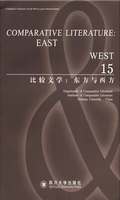
INVITED ARTICLES
Kubin, Wolfgang
What is Good Chinese? Towards the Problem of Literature in the Chinese Commonwealth
Cohen, Tom
" Climate Change" and the Rupture of Cultural Critique
Christie, Stuart
Reading the "Gap" in the Chinese Gorge: Modernist Untranslatability in John Hersey's A Single Pebble
COMPARATIVE STUDIES
Wong, Timothy C.
The Original Evolutionary Nature of Chinese Vernacular Fiction
Zhang, Ziqing
A Dialogue between Chinese and American Poets in the New Century: Their Poetry Reading, Translation and Writing in Collaboration
Bender, Mark
Ogimawkwe Mitiwaki and "Axlu yyr kut": Native Tongues in Literatures of Cultural Transition
CULTURAL CRITIQUE & THEORETICAL DISCOURSE
Ye, Ying
Gender Issues Reflected in Personal and Family Photographs in African American Obituaries
Duan, Lian
Textual Body in City Space: A Psychoanalytic Study of the Representation of
Female Body in Contemporary Photography and Its Social Meaning
Xu, Zhixiao
Gender and Literature: East and West-A Female Scholar's Particular Perspective
Tang, Li
Signifying Chain, Split Subject & Non-transcendental Truth: Similarities between the Thoughts of Derrida & Lacan
INTRODUCTION OF CONFUCIUS INSTITUTES
Confucius Institute at the Arizona State University
Confucius Institute at the University of Utah
NOTICE TO CONTRIBUTORS
精彩片段:
In Steven Spielberg's 2002 adaptation of Philip K. Dick's Minority Report, the narrative concerns the pre-emption of "future" crimes by a form of memory and time back-loop. The film's three sensors are able to foresee crimes and arrest culprits in advance. The pre-emption thereby forecloses the deed (by arresting the would-be criminal). However, on occasion, there is a dissenting opinion among the three that produces a minority report on the "future". I will use this phrase, "minority report"-and the ccompanying image of a memory back-loop that can be controlled, or not-to examine the following hypothesis: that the alternative materialities of today have to do with certain ruptures in our time frame coming from a type of "outside". [11] That is, there are the other materialities that would include: glacial melt-off, the inundation of coasts and cities, mass extinctions, the generation of an underclass of "disposable humans" (today used for body parts), and immment oil or water wars. I will return in a moment to how these "ex factors" have invaded the American media, but will link this shift to another mutation discernible in "cultural studies" and the legacies of conceptual projects. What I will do below-in opening the question of "climate change" and the humanities, and of the legacies of twenthieth-century theory before this shift-is a preliminary scan of the question of a broader re-inscription or hypothesis of 21st century or
non-anthropocene horizons. With this in mind the question posed is of how, and whether, the ex-anthropic factors that interrupt various histories and calculations of irreversible ecocatastrophism (neither fetished nor apocalyptic) operate in the mode of what (after Benjamin) we might think of as translation. Climate change is not, and perhaps could not have been a horizon engaged by Lacan or Derrida, and was never integral to post-Marxian narratives, nor approached by "cultural studies". To suggest that a new concept of climate change would open the prospect of a mutation in the archive, or would produce a revocation of how the archive itself were
configured, oddly turns us closer to, rather than thoroughly arginalizes, reading, reference, and legibilities more broadly.
……

 中国大学出版社协会 |
首页 |
宏观指导 |
出版社天地 |
图书代办站 |
教材图书信息 |
教材图书评论 |
在线订购 |
教材征订
中国大学出版社协会 |
首页 |
宏观指导 |
出版社天地 |
图书代办站 |
教材图书信息 |
教材图书评论 |
在线订购 |
教材征订